open-ai-transformation-maturity-model
Getting Started · Model · Assessment Hub · Roadmap · References
Open AI Transformation Maturity Model (OAITMM)
An open, evidence-based framework for assessing how software organizations evolve from AI-assisted development to autonomous software production.
From copilots to autonomous delivery.
The Five-Level Model
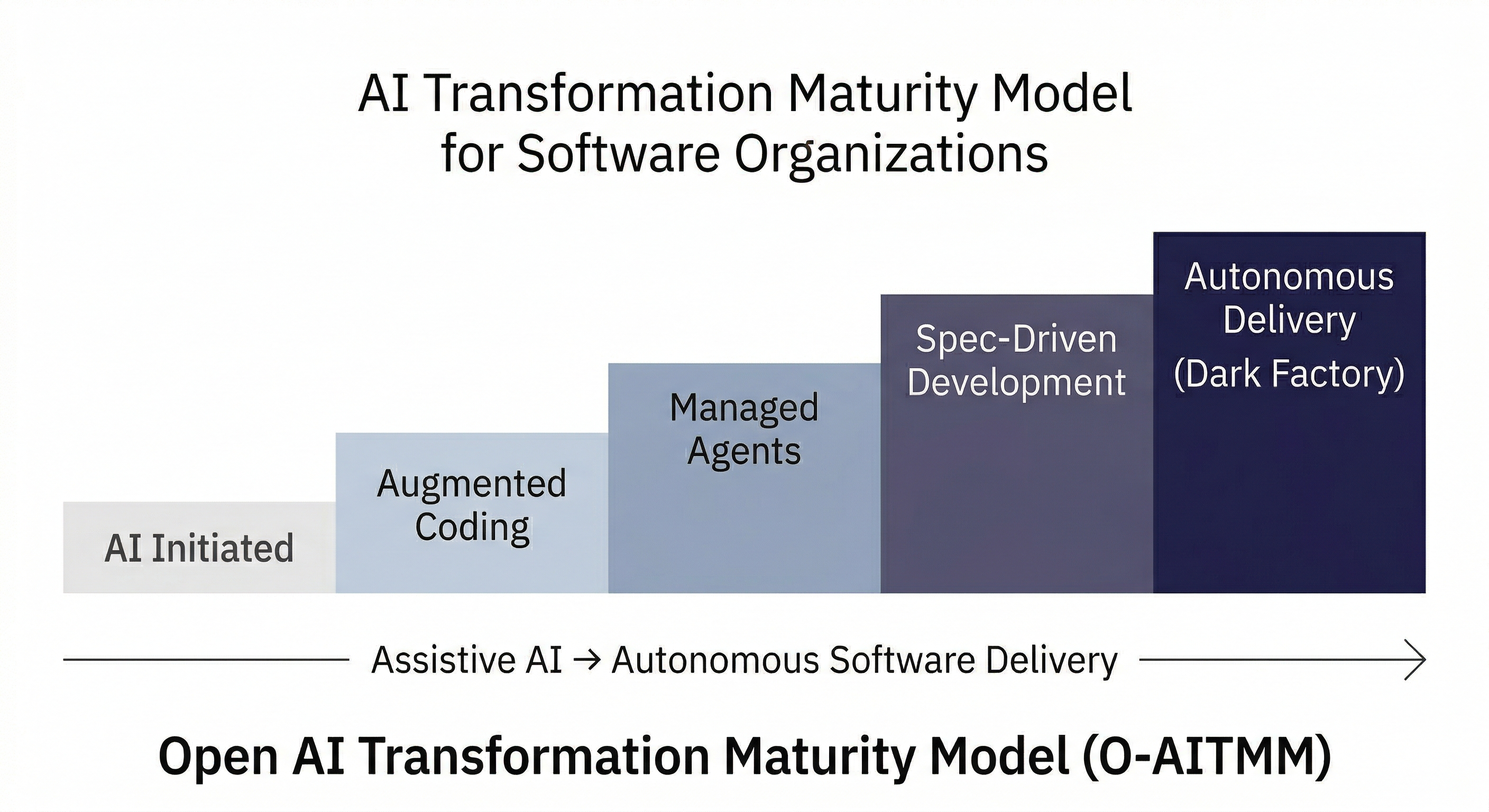
This model describes how engineering organizations transition:
- From human-centric development to machine-executed production
- From code as the primary artifact to intent as the primary artifact
- From implementation bottlenecks to evaluation bottlenecks
- From coordination overhead to constraint design
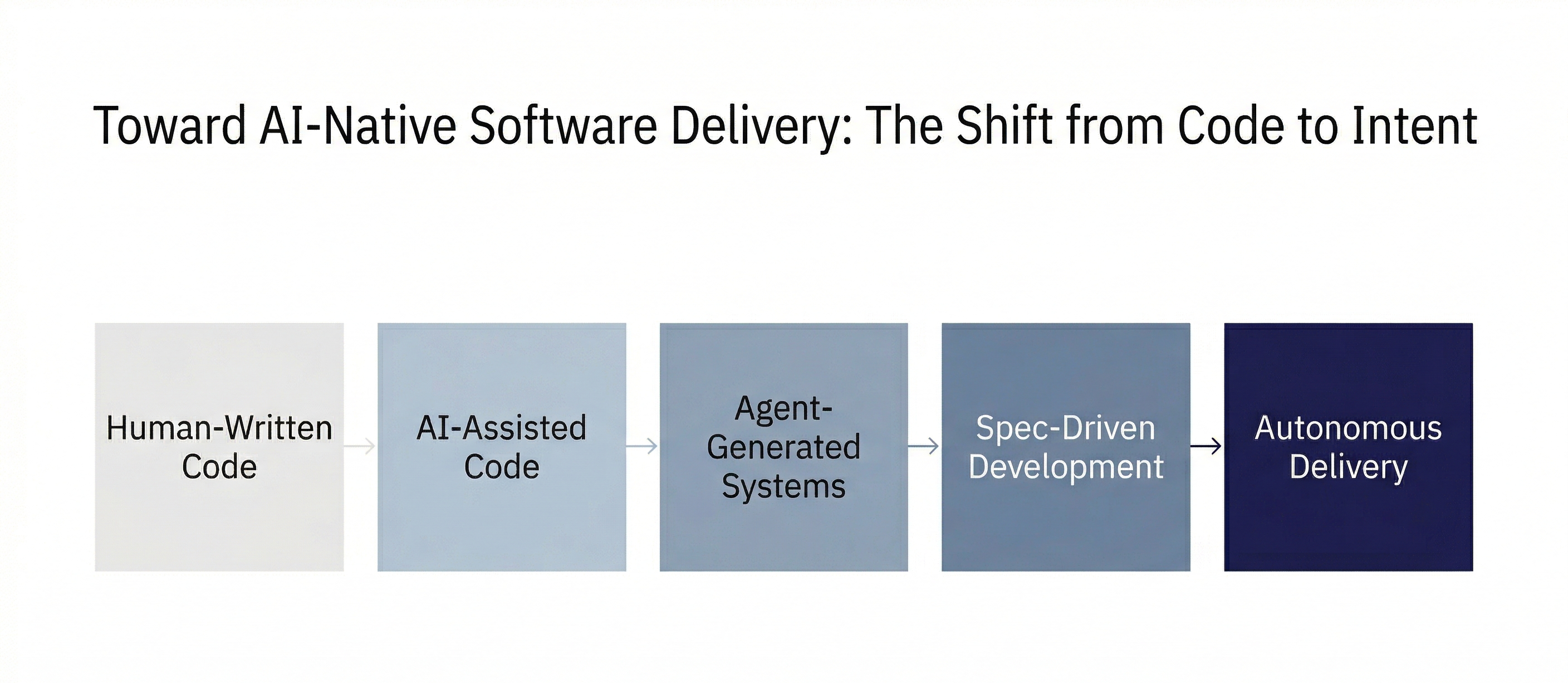
Levels
- AI Initiated — Assistive tools, no structural change
- Augmented Coding — AI as junior contributor
- Managed Agents — Developer as orchestrator
- Spec-Driven Development — Intent as control plane
- Autonomous Delivery — Software production without human coding
📖 Full model:
The model and the assessment framework synthesize insights from contemporary research and industry practice. See References.
Assessment System Architecture
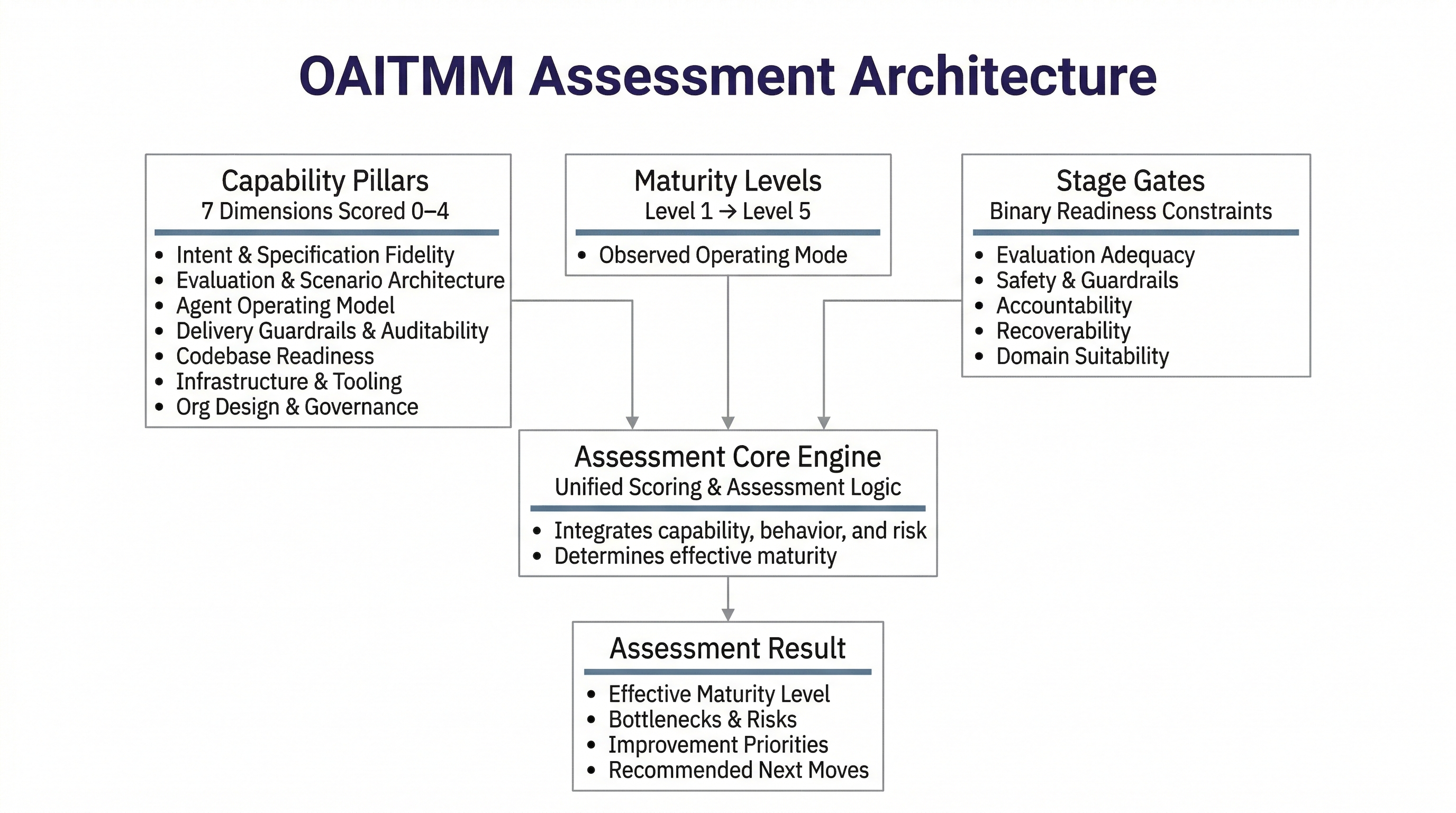
The assessment framework integrates three dimensions:
- Capability Pillars — What the organization can do
- Maturity Levels — How work is performed
- Stage Gates — Safety and readiness constraints
These feed a unified scoring engine that determines effective maturity and recommended next moves.
📊 Full assessment framework:
Why This Framework Exists
Most AI maturity models are:
- Tool-centric
- Vendor-shaped
- Strategy-level but operationally vague
OAITMM focuses on operating-model transformation, not tool adoption.
Who This Is For
This framework is designed for organizations building complex software systems at scale.
It is particularly relevant for:
- CTOs and senior engineering leaders
- Platform and DevOps organizations
- AI transformation teams
- Large R&D organizations
- Consulting and advisory firms
- Researchers studying AI-native software development
It is most applicable where software delivery involves significant coordination, governance, reliability, or safety constraints.
The framework may be of limited use for very small projects, individual developers, or purely experimental environments.
What This Is Not
This framework is not:
- A prediction that all software development will become fully autonomous
- A maturity scorecard for ranking organizations
- A product or tool evaluation guide
- A replacement for engineering judgment or domain expertise
- A guarantee of business value from AI adoption
It does not prescribe a single “correct” end state.
Many organizations will operate across multiple levels simultaneously, depending on domain, risk tolerance, and regulatory constraints.
The model is intended as a reference for understanding operating modes and guiding responsible transformation — not as a mandate to maximize autonomy.
What’s Included
- Formal maturity model
- Detailed assessment framework
- Unified scoring methodology
- Stage gates and readiness checks
- Simulated assessment examples
- Case studies mapped to levels
- Glossary and terminology
- Templates for workshops and self-assessment
- Open contribution model
📘 Supporting docs:
How to Use This Framework
This model is intended as a practical reference for engineering leaders, architects, and transformation teams.
Typical uses include:
- Assessing an organization’s current mode of software delivery
- Identifying capability gaps that block safe progression
- Prioritizing transformation initiatives
- Aligning leadership around a shared mental model
- Tracking progress over time
Most organizations operate across multiple levels simultaneously.
The goal is not to “reach Level 5” universally, but to deploy higher levels where they are safe, valuable, and appropriate.
For structured evaluation guidance, see the assessment framework:
➡️ AI Transformation Maturity — Assessment Framework
Licensing
Unless otherwise noted:
-
Documentation, framework text, diagrams, and assessment content are licensed under
👉 Creative Commons Attribution-ShareAlike 4.0 International (CC BY-SA 4.0) -
Code, schemas, scripts, and tooling are licensed under
👉 Apache License 2.0
Contributing
We welcome contributions from the community.
Examples of valuable contributions:
- New public case studies
- Improved assessment questions
- Domain-specific adaptations
- Diagrams and visualizations
- Tooling and automation
- Corrections and clarifications
Please read:
Code of Conduct
This project is committed to providing a welcoming, respectful, and harassment-free environment for all participants.
All contributors and community members are expected to follow the project’s Code of Conduct.
Governance
This project is maintained by the community with guidance from core maintainers.
See:
Citation
If you use this framework in research, consulting, or publications, please cite it.
👉 Citation File (CITATION.cff)
Status
Active — Initial public release (v0.1.0)
This framework has reached its first stable public milestone and is ready for real-world evaluation and use.
Future releases will refine the model based on community feedback, case studies, and empirical evidence.
👉 See the latest release notes: RN
Software engineering is being industrialized.
This framework exists to help organizations navigate that transition safely and effectively.