open-ai-transformation-maturity-model
Home · Getting Started · Assessment Hub · Roadmap · References
5-Level AI Transformation Maturity Model
License: CC BY-SA 4.0
https://creativecommons.org/licenses/by-sa/4.0/
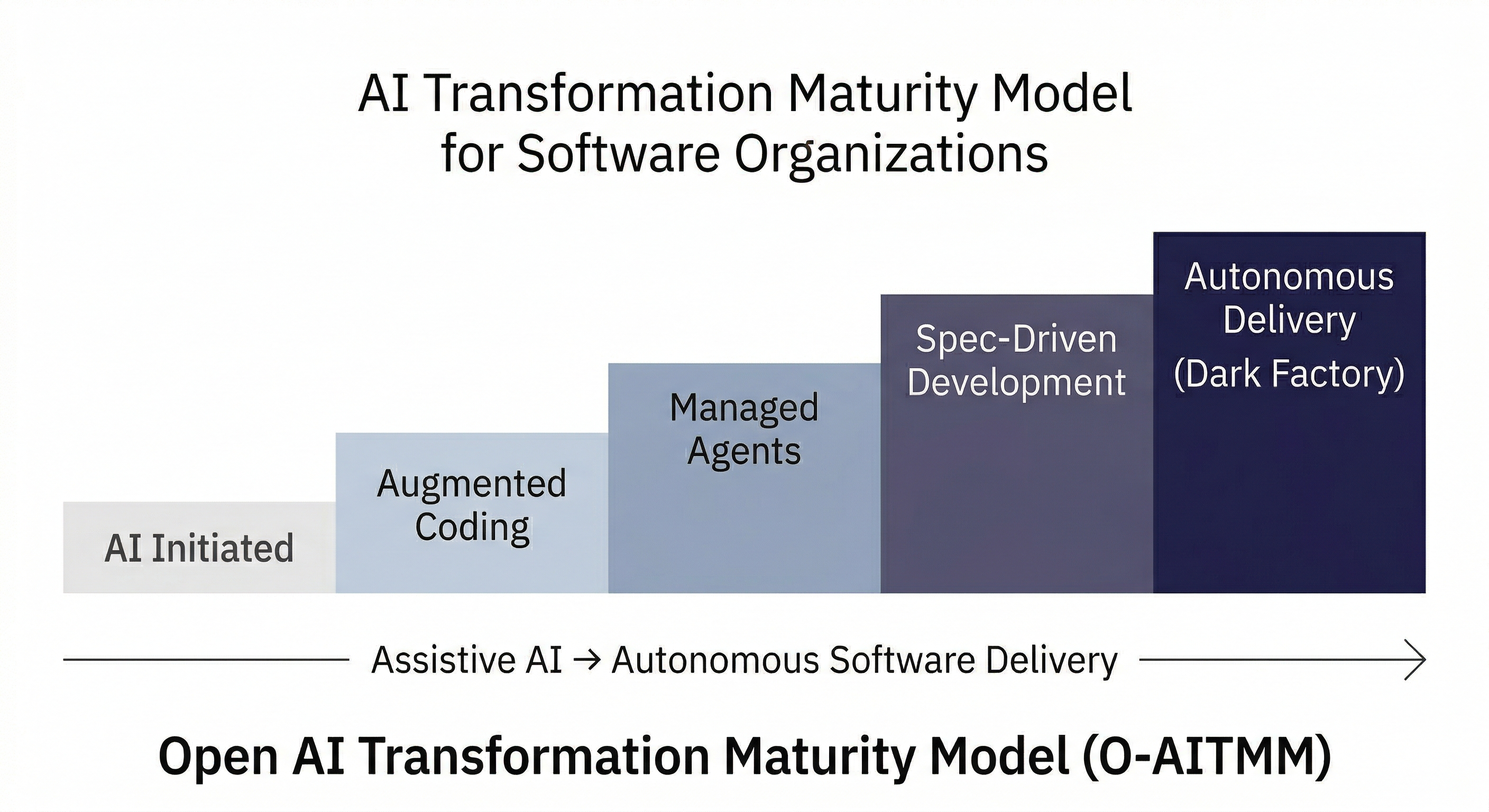
Overview
In reality, most teams don’t “transform” overnight. AI usually sneaks in through side doors — a developer tries a tool, someone shares a prompt in Slack, a manager hears about productivity gains and asks everyone to give it a shot. Over time, these small changes start to add up.
This model is just an attempt to put some structure around that messy journey. It’s meant for engineering leaders and practitioners who are trying to figure out where they actually are — not where conference talks say they should be.
The Five Levels
Level 1 — AI Initiated
AI tools exist, but usage is ad-hoc. Some engineers swear by them, others don’t trust them at all. Official processes don’t change, deadlines don’t move, and most coordination work stays exactly the same. If productivity improves, it’s uneven and hard to attribute.
See detailed description:
👉 Level 1 — AI Initiated
Level 2 — Augmented Coding
AI becomes a normal part of the toolbox. Teams use it for repetitive tasks — tests, boilerplate, small refactors, docs nobody really wanted to write. It saves time, but people still double-check things because the output can be surprisingly wrong in subtle ways.
See detailed description:
👉 Level 2 — Augmented Coding
Level 3 — Managed Agents
At this point, AI can handle larger chunks of work. You might ask it to implement a feature or fix a bug and get something that’s actually usable. Engineers shift from typing code to reviewing, tweaking, and sometimes undoing things that looked correct at first glance.
See detailed description:
👉 Level 3 — Managed Agents
Level 4 — Spec-Driven Development
The bottleneck moves upstream. Clear requirements suddenly matter a lot more, because vague instructions produce vague results. Teams spend more time describing what success looks like and less time deciding how to implement it step by step.
See detailed description:
👉 Level 4 — Spec-Driven Development
Level 5 — Autonomous Delivery (Dark Factory)
In narrow, well-understood domains, the pipeline can run mostly on its own. Changes move from request to deployment with minimal hands-on coding. Humans still set priorities and watch for problems, but they aren’t involved in every commit anymore.
See detailed description:
👉 Level 5 — Dark Factory
Core Idea
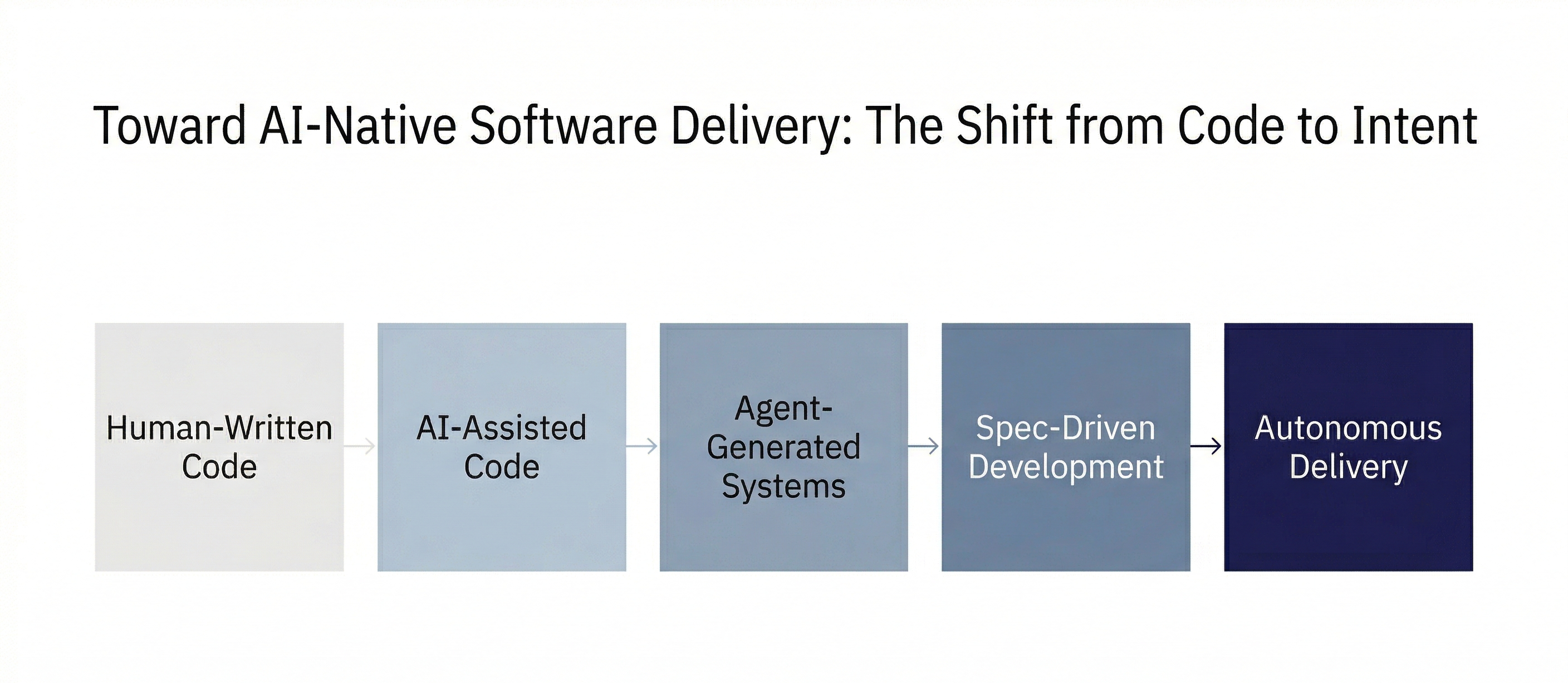
What really changes isn’t just speed — it’s the nature of the work:
- Writing code becomes less central
- Defining problems clearly becomes more valuable
- Delays shift from building things to validating them
- Humans move from doers to supervisors (for better or worse)
What Enables Progression
The five levels describe the dominant mode of software delivery. But organizations do not move up the model simply by adopting more advanced AI tools.
Progression depends on three things working together:
- Operating level — how work is actually performed in practice
- Capability — whether the organization has the supporting systems, workflows, and governance to sustain that mode of operation
- Stage gates — whether operating at that level is safe, controlled, and appropriate for the domain
In other words, higher maturity is not just about using stronger models or more autonomous agents. It requires the underlying capability to support them, and the readiness constraints to make that progression responsible.
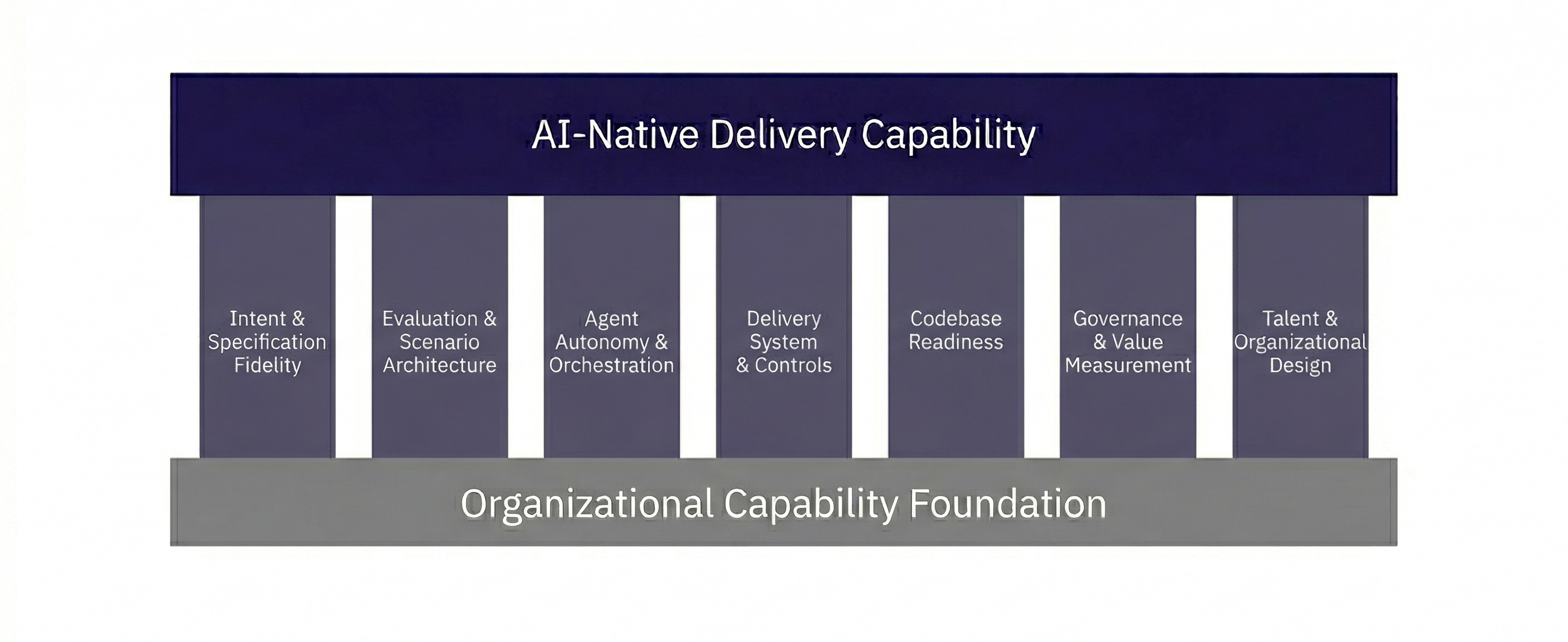
The capability pillars describe the structural conditions that make higher levels sustainable. The stage gates ensure that organizations do not confuse experimentation with readiness, or autonomy with safe production operation.
The detailed scoring logic, pillar definitions, and gate criteria are described in the assessment framework.
➡️ AI Transformation Maturity — Assessment Framework
The assessment framework includes:
- Unified scoring methodology
- Seven capability pillars
- Stage gates for safe progression
- Observable level checklists
- Worked examples for interpretation
How This Model Can Be Used
Teams might use this model to:
- get an honest sense of where they are today
- align leadership on what “progress” actually means
- plan next steps without magical thinking
- compare maturity across groups
- have more grounded conversations about AI adoption